
Dissecting Whiplash's Opening Sequence (Extended)
- Fatima Asad
- Mar 3, 2024
- 5 min read


Salutations everyone!
Welcome yet again to another post as endeavour try to lessen my workload. This afternoon, I will be analyzing "Whiplash(2014)"'s opening. Now, without wasting a second, let's get into it.
The movie opens with a black fill with a beat in the background, produced by what can be assumed to be a drum set. This is a non-diegetic sound as the source is undefined in the shot. There is a gradual starts fade in along with a dolly camera movement. It seems like the dolly is implying the main character's focus, because, as the camera is interrupted, the focus is broke. The dolly is swift, yet done at a steady pace.
As the drummer's rhythm increases, the overall implications of the scene or movie as a whole can be interrupted as very fast paced and intense. The position of the camera creates depth of field as the interior walls narrow at an angle, approaching the drummer.
The intensifying rhythm correlates with the dynamic use of depth of field, emphasizing the drummer's increasing commitment and the impending challenges he faces. The narrowing walls not only visually enhance the drummer's isolation but also create a sense of claustrophobia, amplifying the pressure he experiences.

The sound now shifts to diegetic sound , considering that the
main source is visible to the audience. The camera movement and the sound are parallel to each other.
The transition to diegetic sound aligns with the visible presence of the drum set, creating a synchronized auditory and visual experience. This strategic alignment contributes to the immersive nature of the scene, heightening the audience's engagement.
The composition of the shot shows the isolation of drummer's practice, revealing that the life of a musician is solitary and stark. The light in his practice room is the only one in the shot, and we see him from a distance, heightening a sense of his removal from the rest of the world.
The deliberate composition underscores the thematic element of isolation, employing visual cues to depict the solitary journey of a musician. The use of minimal lighting not only accentuates the starkness of the practice room but also symbolizes the individual's pursuit of excellence in a challenging environment.
The opening sequence has mostly been shot with lowkey lighting, which is typically used to show conflicts. There is a heavy atmosphere and a sense of desperation engulfs the drummer. As the camera closes in, we can see the sweat and exhaustion on the man's face.
The strategic use of lowkey lighting intensifies the conflict-driven atmosphere, casting shadows that visually represent the internal struggles of the character. The close-in shots further emphasize the physical toll of his dedication, with perspiration and exhaustion becoming palpable elements of the narrative.
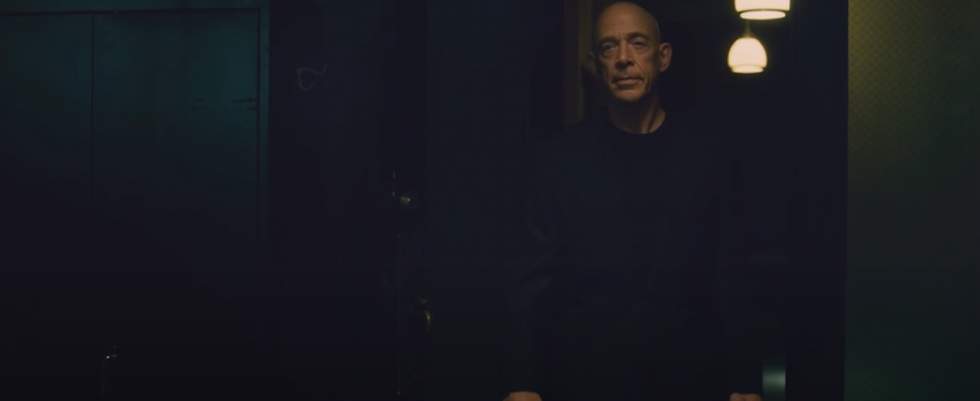
The first instance when speech is heard is with an apology from the drummer as he realizes he is not alone. The movement down the hall is used to stimulate the perspective of an onlooker. This is the observer and the camera cuts from the drummer to a mid shot of the man. He is dimly lit and the lighting does not fully distinguish him from the background. The drummer is seen to be wearing white, with the sole light in the room is focused on him while the newcomer is dressed in black and is enshrouded in shadows. This creates a contrast and depicts both the characters roles as good and evil.
The shift to dialogue introduces a layer of narrative complexity, with the movement down the hall emphasizing the observer's perspective. The use of contrasting lighting and attire symbolizes the dichotomy between the characters, employing visual metaphors to establish their respective roles.
The visitor has a stern and unapproachable look as he starts barking orders the moment he arrives. The sound of his voice is a strong prominent one that seems to fill the space, again highlighting his authority and strong character, as opposed to the drummer's meek and soft gentle tone.
The authoritative entrance of the visitor is accentuated by the commanding sound design, with his voice dominating the auditory space. This stark contrast in vocal tones contributes to the establishment of power dynamics, setting the stage for the ensuing conflict.
When the two characters have their first interaction, the camera is angled slightly lower when it is focused on the drummer and when the camera is focused on outsider, it is angled slightly higher in order to convey the power difference between the two.

The strategic use of camera angles enhances the visual storytelling, with the slight lower angle emphasizing the drummer's vulnerability and the higher angle accentuating the outsider's dominance. This subtle manipulation of perspective reinforces the power dynamics at play in the scene.
Another thing to note is that the camera cuts whenever someone is talking. Both the men never appear in the same shot, even while being in the same room. This shows that they don't have a connection and further contributes to creating an even tenser atmosphere around them, all in an effort to keep the audience engaged and excited. The next minute passes as the scenes cut between two mid shots that coincide with the character's dialogue.
The strategic use of cutting between characters' dialogue enhances the sense of disconnect and tension, with the absence of shared shots symbolizing the lack of connection between the characters. This deliberate editing choice intensifies the atmosphere, ensuring a continuous sense of anticipation.
The next movement instilled is another dolly into the characters face as he is getting into this “double time swing” as directed. The camera moves in closer to his face removing the drum set from the foreground. This close-up is also an emotional representation of the character as one can tell that he is in his mind, focused on the beat.
The dolly movement into the close-up serves as a visual cue for the audience to delve into the character's emotional state, emphasizing his mental immersion in the music. The removal of the drum set from the foreground directs the viewer's attention solely to the character's facial expressions, intensifying the emotional resonance.

He is abruptly awoken from his focus when his attention is drawn to the slamming of a door. The noise is (non-diegetic) because the camera still has his face in the shot although it is understood that someone has left the room. The camera pans quickly to the right to another mid-shot of the door. This time it is closed and the man is absent from the frame. His loneliness is further reinforced by the silence in the room other than the rustling of his drumsticks. The sound of the shutting door in the background at the end of the sequence also shows the constant element of failure through this process, setting the tone for the rest of the film.
The sudden awakening from focus, coupled with the non-diegetic door slam, creates a jarring shift in the atmosphere, underscoring the disruptive nature of the sound. The rapid pan to the closed door visually signifies the departure of a significant presence, heightening the sense of isolation and failure.
The man returns to the room for a moment, creating a sense of hope, which is quickly diminished as he leaves once again (with his coat this time).
With this, we come to an end to the opening sequence as the scene then cuts to a series of establishing shots in order to justify the setting and time. This intense opening grabs the audience's attention right away, and sets the stage for the competitive world inside the movie. It also establishes the main character and his motivation, which might resonate with many people.
The transition to establishing shots serves as a narrative bridge, providing contextual information while maintaining the intensity established in the opening sequence. The careful selection of shots contributes to the audience's understanding of the setting and time, creating a seamless transition into the broader narrative.
This is it for this post, see you again in the next one!


Comments