
Analysing the Opening Sequence of Inglourious Basterds (Extended)
- Fatima Asad
- Mar 3, 2024
- 6 min read


Good Evening!
Today I chosen to analyse the opening of "Inglourious Basterds" , marking it as the second WW2 based film that I have analysed. You might be wondering where my interest in such movies stems from! As someone who took History in both O and A Levels , I have studied this period extensively. However, academic studies can sometimes detach us from the human side of tragedies; the deaths are just numbers on a page. Watching films set int his era offers another perspective, bringing the emotional weight of history to life, thus allowing you to truly acknowledge the human cost of war. Now, without wasting anymore time dallying about, let's get to the analysing part of the post!
Inglourious Basterds has a 'prologue scene without voice over' type of opening. The opening scene is an incredibly long one, almost 20 minutes, but its extremely tense from start to finish. This scene introduces the antagonist, sets up the motivation of a main character, situates you in the world and tone of the movie, and expertly wields subtext to create suspense and interest.

The film opens amidst the serene backdrop of a dairy farm in Nazi-occupied France, providing a tranquil setting that starkly contrasts with the impending danger lurking beneath the surface.
The first set up is a low english shot and shows a farmer chopping wood and his daughter hanging clothes on a line. The use of low english shots and shots of domestic life serves to establish a sense of normalcy before the intrusion of danger. The gradual escalation of tension is palpable as a car comes into view, heading for the farmer's house, disturbing the tranquil settings and signalling imminent danger for the farmer and his family. The way that the family reacts to the car makes the arrival seem even more ominous.


LaPadite sits up and organises himself. There is a close up of him followed by an over the shoulder shot of the laundry being penetrated by the approaching car. There are few basic camera movements with symbolic potential such as a man and a home with a buried hatchet. By now, 3 minutes have been spent with us just watching LaPadite, and this builds tension.
As Landa approaches, the camera moves for the first time beyond panning. The camera movements align with Landa's every move, emphasising his dominance and control. The deliberate framing choices underscore the power dynamics at play, heightening the sense of unease and anticipation.Approaching the farm, Landa walks towards the sun while LaPadite waits in the shadow of it
This makes the edges of Landa's angular face peak and valley in intensity quite harshly while LaPadite remains quite even and darker than the approaching and foreboding figure. Landa's hat cuts a line across his eyes which also means he can stare LaPadite in the eyes without squinting or blinking.


Landa is uncomfortably polite as he greets the farmer and his family. When Landa enters the house, the first viewpoint is between the two daughters as if we are standing with them. This is followed by a reverse shot and it seems like the view has rotated a full 180˚. This square framing seems limiting, trapping us as the visual scheme aligns with us emotionally. The strategic use of camera positions, such as over-the-shoulder shots and close-ups, allows Tarantino to manipulate the audience's perception and create a sense of intimacy with the characters. The shifting perspectives enhance the emotional resonance of the scene, drawing the audience deeper into the narrative.


When Landa moves across the room, the camera crabs left to reframe Landa, once again showing that Landa is in full control of this encounter. When Landa is asked to sit, the camera again follows him. It's a subtle pan to the right. There is a close up of the daughter's face as she glances towards the farmer, hinting that something is wrong. When we cut back to a medium shot of Landa, it's different. It's a low angle shot framing Landa as more powerful, more intimidating figure.


When Hans Landa first sits down, the camera is set on a medium-wide, and the camera is focused on a corner in the room. After some close-ups of the farmer and his daughter, we return to Landa, but this time, the camera’s at a lower angle. This conveys Landa’s power in the room, and it denotes a shift in tone within the scene. This may be the farmer’s home, but Landa holds all of the cards. The framing emphasises Landa's importance by positioning the camera at eye level with him, while LaPadite's perspective, looking down, conveys his vulnerability and insignificance. Each time they speak their respective coverage has the speaker centred, dominating most of the screen. The farmer comes to sit at the table the camera pans right and reframes for a two shot. There are long static takes in this scene which is part of the strategy to draw out tension. The prolonged takes and master shots serve as a strategic choice to draw out tension and maintain audience engagement. By allowing the scene to unfold in real-time, Tarantino creates a palpable sense of anticipation, building towards the inevitable climax.


Lighting also plays a crucial role in setting the tone and mood of the scene. Characteristic of the "at the table" dialogue sequence is the bright overhead light that strikes the wood table with such intensity that it blows out and key-lights Landa's face. Not only is this natural and convincing on the surface-level, but also it is effective at providing visual interest and increased intensity to the scene. We effectively have a noire-style overhead light breaking apart the image to contrast against the soft light coming in from the windows; this is an interrogation. At this very same table, LaPadite's face is quite softly lit as if the light source from the window on frame left is brighter than the over-exposed bounce light below him. The overhead light striking the table quite obviously (upon review) changes intensity from take to take to account for who the subject of the frame is and what actions are being taken by the talent. The uneven exposure further allows the audience to easily see the subtle changes in Landa's facial expression from polite to suspicious to venomous quite easily.
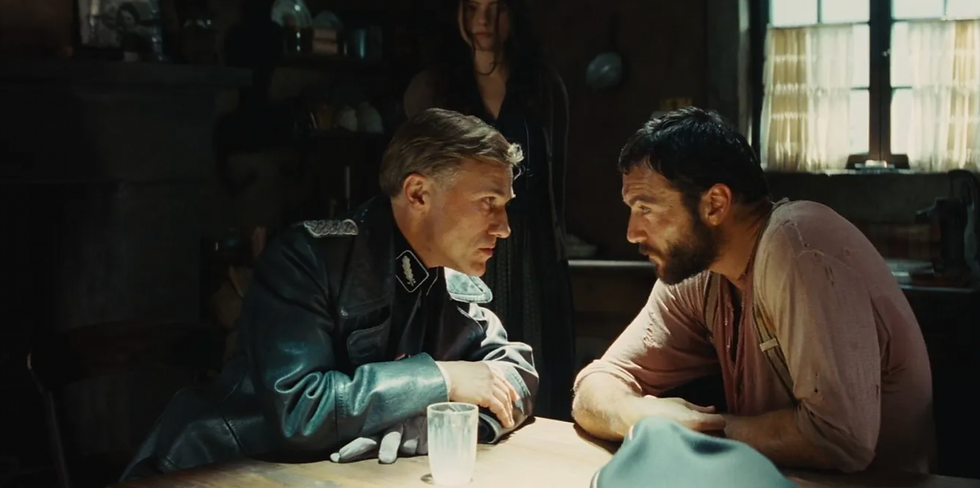
With the farmers daughters leaving, the purpose of the conversation becomes clear, the tone of the scene shifts. The camera angles also shift. It is medium wide, camera height being eye level, about to settle in a conversation, where Landa verbally outmanoeuvres the farmer. As a filmmaker, you want to prevent your audience from getting bored, especially during long conversation scenes. One way you can do that is by changing up your framing based on changes within the conversation taking place between your characters. It is quite a long take and serves as a master shot. In addition to the master, we have the over the shoulder medium shot of the farmer and a corresponding reverse over the shoulder and medium of Landa. This is a textbook conversation scene with the camera roughly at eye level and the characters simply chatting. The whole conversation is a cat and mouse scene, when forces of power and potential violence enters the scene. As a filmmaker, you want to prevent your audience from getting bored, especially during long conversation scenes. One way you can do that is by changing up your framing based on changes within the conversation taking place between your characters.
I believe I will only be able to carry on my analysis till this point. The opening to this movie is quite a long one and I have covered roughly 5-6 minutes of it up till now. As a conclusion, I would like to say the opening sequence of "Inglourious Basterds" stands as a testament to Quentin Tarantino's mastery of cinematic storytelling. Through meticulous attention to detail in framing, camera movement, lighting, and pacing, Tarantino crafts a scene that is as visually stunning as it is emotionally gripping. The deliberate choices in framing and lighting not only serve to underscore the power dynamics between characters but also enhance the overall tone and mood of the scene. As we immerse ourselves in this cinematic experience, we are reminded of the profound impact of film in bringing history to life and fostering a deeper understanding of the human experience.
With that, I bid adieu to this exploration, eager to embark on future cinematic journeys that continues to captivate and resonate with audiences around the world.


Comments